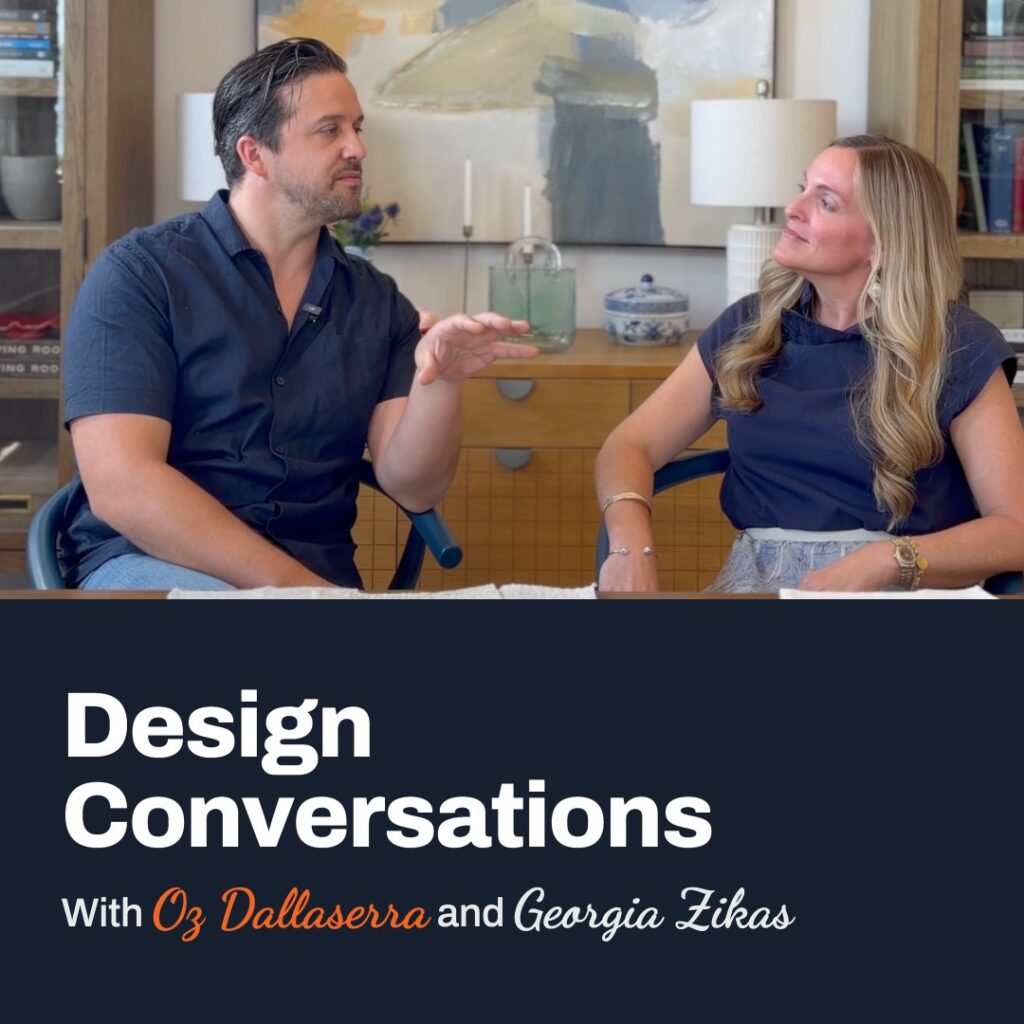
Design Conversations With Oz Dallaserra & Georgia Zikas
On Relationships, Process, and the Art of Interior Design
A conversation between Oz Dallaserra of New England Design & Construction and Georgia Zikas of Georgia Zikas Design.
Oz Dallaserra and Georgia Zikas sat down at Georgia’s beautiful office in South Boston to talk relationships, process and the art of interior design:
G.Z. You were asking me what my favorite part of the job is, and that’s when I realized we have the same favorite part of our jobs.
O.D. We do. So why don’t you tell me what that is?
G.Z. Meeting the client. My favorite part is meeting the client, and then the high-touch onboarding — learning what they need, what their family’s like. I kind of joke that I want to know what you eat for breakfast. I really go deep early on getting to know people, and I think the relationship building is everything to me. It’s definitely my favorite part.
O.D. I love it, 100%. I concur.
G.Z. No, Dave, you weren’t asking me this — I told you, honestly: if I didn’t have to work, I would still do it for free. I would do design consultations for free, simply because going into a space — I think sometimes you take for granted what you can see in a space that most people actually can’t. When you come into a space, you have a vision for the future: how it will fit that family, how it will help solve their problems, both from a technical layout standpoint and an aesthetic standpoint.
O.D. It’s a gift — one you might not even realize you have. I totally agree. I think we take it for granted that we can walk into a space and almost see the end already.
G.Z. It’s the middle — and getting there — that’s the journey. I don’t think it’s taken for granted that not everybody has that. Certainly not the client. There are lots of other creatives who can see things, but I think it is truly a gift.
O.D. Yeah, and it’s fun to draw that out of someone — to watch them see the process unfold. That’s exciting.
G.Z. I love that. It’s funny — I was comparing it to painting earlier, because it is an art form: to see a space and creatively come up with something that wasn’t there before. But as a painter, it’s really you and your canvas. With this, you’re painting with people there — that extra element of humanity involved in the creation.
O.D. Sort of in real time, like that painter analogy — if a painter is painting a landscape, they’re in connection with the landscape. What we’re doing is a little bit of improvisation too. You’re in real time.
G.Z. 100%. That’s great — the connection to the people. We were talking in another conversation about how no two homes are the same, and no two clients are the same. That’s where the improv comes in — I think it’s a life skill as much as a design skill.
O.D. Totally. It could be very daunting if you’re not comfortable going into a space and coming up with something on the spot — almost stage fright, like “oh my god, I’m going to have to come up with something.”
G.Z. Not to toot my own horn about it coming naturally, but it is wonderful to have pleasure in exercising that skill. It’s like cooking for me — if I had to cook for people, I’d be mortified. But this, to me, is pleasure.
O.D. To some people it might not be, but passion shows in certain fields, and yours shows. What I was most amazed by with you and your firm — well, you yourself are great, we clicked the moment we met — but what really impressed me was how thorough your process is, walking us through everything, all the books you have. How did you come to develop such a refined process for interiors?
G.Z. It came from literally putting myself in the shoes of a client. To dovetail on that first question — when meeting with a client, I could sometimes see the stress on their face: what to expect, how does this flow. So about seven or eight years ago I really started honing in and refining our process into a step-by-step framework — one that still allows for open collaboration between architect, builder, and client. It came from a real need: that client was a little nervous about what to expect, so I said, “okay, here’s how we do it,” and I could see the relief that framework provided. From there we just kept riffing — it started simple and got better and better over the years, and I think we’re in a really good place, based on the feedback clients have given us.
O.D. That’s awesome — it’s almost like having the rails up when bowling. I’ve actually used that exact analogy: bowling with bumpers.
G.Z. Bowling with bumpers — they’re not going to steer you wrong. I use that same strategy: I’m not going to show you anything I wouldn’t want to use in my own home. It’s not my home, but it’s going to be of a certain taste and preference — we’re not going to steer you wrong. You’ll have plenty of choice, not limitless, but you’re not going to make a bad choice.
O.D. Because you’ve got the guardrails up. I love that. Sorry to cut you off — sometimes with an interior designer, people could argue — and I’m sure this would be offensive to some — that you’re boxed into a style, that’s your style, and people hire you for it.
G.Z. Sure, I’m sure there’s an element of that — there is a specific style people might lean toward. But I really liked what I was saying earlier about the client who walked into a space — let me tell that story again, because I love it. When we talk with a client early on, whether they come through a referral or another source, when we talk about style I always say I don’t have a particular style, I have a process. It’s really informed by architecture, location, and the people. I had a new client come to us — a referral from an existing client we’ll call Mary, in Greenwich, Connecticut. We’ll call the new client Jane.
Jane came in and said, “I went to Mary’s house — I’ve known Mary for decades — and when I walked in, I could see it was fully Mary. Just an elevated version of Mary that I knew she couldn’t have achieved on her own.” That, to me, was the biggest compliment — that Jane could see Mary’s fingerprints all over the place, even though I knew Mary needed help getting to her highest potential. That’s what we do best: take the client’s direction and bring it to the highest potential possible.
O.D. I love that. It’s a real testament to how thorough your process is — that you brought in the people, the architecture, and the location. That’s really nicely put.
G.Z. And no two are ever the same — that combination is always going to be different throughout the world. That’s why it’s great for interior design to speak to all three points. We work in multiple markets, and different means and methods come from those markets. We’re working on a project in the Midwest right now — a totally different culture than the West Coast or East Coast, even the building materials are different. That’s what’s most fun: learning what’s best practice for each area — it’s improvisation in the early stages, learning the culture, the lingo, the light touch of introducing yourself. I find all of that fascinating.
O.D. Do you ever get pushback from clients — have you ever had to change direction after presenting something?
G.Z. Great question. Because of that heavy lift with onboarding, we’re getting to know people really early, so we haven’t had pushback on design direction. But we’ve had a couple of interesting reactions to a presentation — we’ve had a client weep.
O.D. Wow.
G.Z. She’s a beloved client we’ve now had for seven years, three projects. She wept and said, “I don’t know if I deserve this.” Of course you do — but it was reimagining a space she knew, showing it in 3D rendering, the materiality — she wept with joy. It was really about learning the emotional detail behind people’s homes. Primary homes bring out the most emotion — a secondary or vacation home, things can be a little less intense. But primary homes are very delicate; some clients have lived there twenty years or longer, or even just bought it — it’s its own journey. It’s their space, and it’s really for them.
O.D. That’s so beautiful — it really shows the testament that this is an art form, and the way it touches people. Our tagline is “lifting spirits of spaces.”
G.Z. I love that. To hear someone weep and ask “do I deserve this” — that’s beautiful, because it’s where they live, and it’s going to touch their lives and lift them.
O.D. I think our companies are aligned on that — it’s far beyond design, far beyond dwellings. It’s so relationship-focused and experiential that clients keep coming back.
G.Z. And that’s the ultimate compliment. I love how our CEO Dave says it so well: it’s the undocumented journey. We all have pretty pictures — not all, but mostly — but the undocumented journey that got you there is the real story: how did it go, how smooth was it?
O.D. I often say — and I know you’re in the same boat, different pond, with construction and build — for designers, I don’t envy the seat clients are in when choosing who to partner with. At a certain level, you’re always going to get a beautiful result. What I like to say is: who you choose is going to make the experience ultimately different. You can guarantee a beautiful room, pretty pictures — but the journey along the way can be wildly different, depending on which firm you choose. Same with construction and architecture, of course.
G.Z. It’s a partnership. You’re not buying shoes — you’re in it for the long haul. It’s a long game.
O.D. We’re a design-build firm, obviously, and we do it all. But there’s an elevated element that comes from bringing in an artist — an interior designer like yourself — that extra layer that makes a space feel truly finished. Selfishly, I always love partnering with interior designers, because it elevates the project and the final results are mind-bogglingly beautiful. We work well with interior designers because, as an architecture and construction firm, our process is actually very similar to yours — very delineated — which helps everyone understand what the next step is and who’s doing what.
Let me ask you this: what’s your preference when working with architects and builders?
G.Z. As far as process goes, I don’t have a preference beyond a really nice, friendly kickoff meeting on roles and responsibilities, just to see where there are any overlaps — because I never want a client to pay twice for the same service. That initial communication of who’s doing what matters, especially since most of our projects have an architect involved — there are certain levels of detail with elevations, millwork, and things like that. That’s the housekeeping conversation. Beyond that, it’s collaborative the whole way through. Clients don’t always understand that up front, but we’re all there for the long haul — really there to the end, tucking them into bed, quite literally.
O.D. Quite literally — with a soft furnishing.
G.Z. That’s always going to be the case. My preference really comes down to good clarity of communication — for everyone involved, but especially with the client — so everything moves smoothly and the joints are, well, oiled.
O.D. Well said. That’s our biggest selling point too — single source of accountability for the client. That doesn’t mean it’s one person one-on-one; it takes a village to achieve the final product.
G.Z. That’s where the collaboration and the smoothness come in — joining hands while still acting as a single source of accountability for the client.
O.D. And you mentioned a word I love: accountability. Always do what you say and say what you do.
G.Z. That’s what makes the best team — and the best outcome, and the best client experience.
O.D. Totally agree. What’s your favorite part of the design process? Tough question, I know.
G.Z. That’s like asking me who my favorite kid is. As I mentioned earlier, the relationship building is really my favorite part — learning who the client is, learning what their needs are, meeting them where they’re at, whether we’re brought in midstream or even before a property is purchased.
O.D. Do you ever get brought on as an interior designer before the purchase?
G.Z. I’ve actually house-hunted with clients.
O.D. Wow.
G.Z. That’s another level of service we’re equipped to do, and have done for years. We’ve had clients say, “Can you look at a few properties with us?” — and we’ll bring in a builder too, to say, “if we want to move this kitchen, how feasible is it?” That’s the level of trust we’re fortunate to have.
It’s really fun too — we’ve had clients where the project wrapped long ago, and I’ll get a text asking what color orchid to buy, or “my daughter’s getting married, can you weigh in on bridesmaid colors?” There’s a long-term relationship that keeps going.
O.D. They become friends.
G.Z. They do. It’s a business agreement in the beginning, but without fail, we become friendly.
O.D. And that’s just the ultimate compliment. I love it — that’s great. You rock!
G.Z. Thanks. So do you!
You can follow Georgia’s beautiful work here:
Download NEDC’s complimentary 2026 Boston Home Remodeling Cost & Schedule Guide Here: