What is Design-build?

What does design-build remodeling mean?
“Design-build” has become a bit of a buzzword in the home remodeling industry, and with good reason.
Homeowners who partner with design-build firms typically enjoy accurate budget estimates, short project timelines, and clear communication.
Design-build remodeling means that a single firm handles your remodeling project from beginning to end. Whereas most homeowners are accustomed to hiring an architect and construction manager separately, a design-build firm has both professional architects and professional builders on staff so that all project professionals are under one roof. In other words, one firm takes care of the entire project.
Benefits of working with a Boston design-build firm
The benefits to employing a design-build firm on your project are plentiful; but three really stand out:
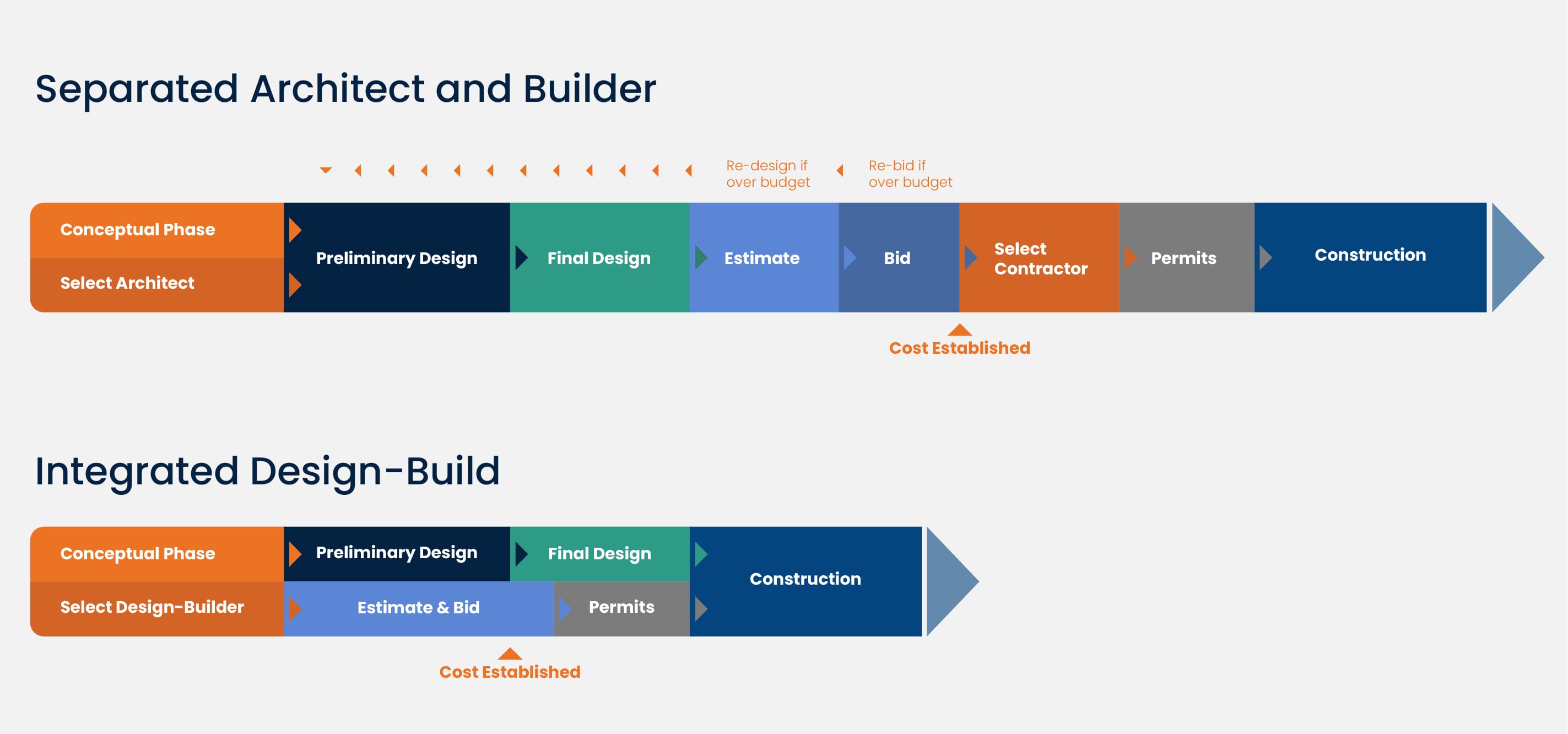
- Save Money: Typically, homeowners hire an architect to create plans, pay the architect, and then take those plans to a builder. Unfortunately, it’s all too common for there to be disconnects between architects and builders. Architects tend to have a more theoretical knowledge of your project, whereas builders have an “on the ground” understanding of practical considerations like which materials are on backorder or which designs will require specialty contractors who may not be available until months down the road. Because of this, “finalized” designs may need to be taken back to the architect and reworked. And the homeowner pays. In a design-build model, on the other hand, the architect and the builder are both involved in your remodeling project from the very beginning. Each design element the architect introduces is checked by the project manager in real-time, preventing you as the homeowner from unwittingly making costly mistakes.
- Save Time: This is also why hiring a separate architect and builder can cost you in time as well as in money. When architects design without input from project managers, they may not be aware of potential project delays due to zoning laws, permitting issues, material shortages, and complex designs that require specialty contractors. On the other hand, design-build firms like NEDC have fine-tuned formalized steps to take the project from ideation to completion with clear communication between all parties at all stages. This increases clarity and allows you as the homeowner to make well-informed decisions and thus have greater control over your project.
- A Single Source of Accountability: Another reason homeowners prefer the design-build model is that there’s a single source of accountability. Architects and builders are on the same team, so instead of ambiguous answers and blame games, you get clear communication and collaborative problem-solving.
The NEDC design-build process
Our design-build process consists of ten steps:
- Complimentary In-Home Evaluation — A designer visits your home to assess your needs, lifestyle, and goals, and discusses preliminary budget and our process.
- Pre-Design — Your lead designer gets to know your style through surveys and an on-site kickoff meeting, laser-scans your space for accurate floor plans, and researches zoning, codes, and any consultants needed.
- Schematic Design — We present multiple design directions in plan and 3D, refine them into one favorite layout based on your feedback, and prepare your first budget.
- Design Development — You select finishes at showrooms and review renders and VR walkthroughs; your project manager is assigned, subcontractors price the job, and your second budget is presented.
- Construction Documentation — We finalize any remaining design details during the permit approval process and assemble the final contract package: plans, budget, scope, and selections.
- Pre-Construction Meeting — A kickoff meeting at your home covers communication, material and tool storage, dust protection, work hours, and any special requests before construction begins.
- Weekly Meetings — You meet in person with your project manager each week throughout construction to stay coordinated and get questions answered.
- Substantial Completion Walk-Through — We walk the finished home together, build a punch list of remaining items, and hold back their value from your final invoice until they’re resolved.
- Post-Construction Wrap-Up & Project Binder — After you’ve settled in, we meet to gather your feedback and hand over a project binder with contracts, construction documents, renderings, and fixture/appliance information.
- Warranty — Every project is backed by a 5-year service warranty, with periodic check-ins to make sure you stay happy with the result.
History of the design-build method
What do the pyramids, the Parthenon and the Pentagon all have in common? They were all built on the same tried and true method: Design and Build. But what is Design-Build and how did it start? To understand this, we’ll need to travel over 5000 years back in time to Ancient Egypt, where man was building the first pyramids. These magnificent structures were built by individuals known as Master Builders.
The Master Builder was responsible for the entire project from design through construction. In fact, Design-Build became a law about 2000 years later in the kingdom of Babylon. In years to come, the Parthenon, the Theatre of Dionysus and other long-lasting structures would be built. Design-Build continued to work very well for man until the Renaissance, when architects decided they wanted their own profession as distinct from the builder.
Architects started designing their own projects and putting them on the market for builders to bid on them. And so the traditional method of building, Design-Bid-Build, was born. This was intended to improve the aesthetic appeal of construction, and did so until the Industrial Revolution began in the mid-1700s. At this time, there was an ever-growing demand for large quantities of warehouses and industrial complexes. As such, collaboration ceased and projects lost their quality. Aesthetic appeal became of little or no consequence.
In the last decade, we have seen a changeover from Design-Bid-Build to Design-Build. The reason for the changeover is simply the involvement required in modern-day projects. Take, for example, the Pentagon, considered the world’s most complex building. This was built using the Design-Build method. Growing interest in energy-efficient homes has greatly contributed to the need of close collaboration between designer and builder.
So it is now as it was in the beginning. The return to the time-honored approach of Design-Build is ever-growing and has surpassed that of Design-Bid-Build. The future of our world’s architecture and construction is inspiring, as we see more Design-Build projects like the Burj Khalifa (the tallest building in the world) and state-of-the-art sports arenas erected across the globe.
“The time for extracting a lesson from history is ever at hand for those who are wise”
Demosthenes, Statesman; Athens, Greece (384-322 BC)